RLT · Category
Live Roulette in the UK: How the Online Tables and Their Wheels Work
Live roulette in the UK is the most widely offered live casino category, and the one where the differences between tables are easiest to see: the wheel itself, the rules applied when the ball lands in zero, the speed of the round, and whether the table sits in a studio or on a real casino floor.
This page sets out how the format works and which of those differences are properties of a specific table rather than of roulette. Anything that belongs to an individual table, and that we cannot source, stays marked as unknown rather than being filled in.
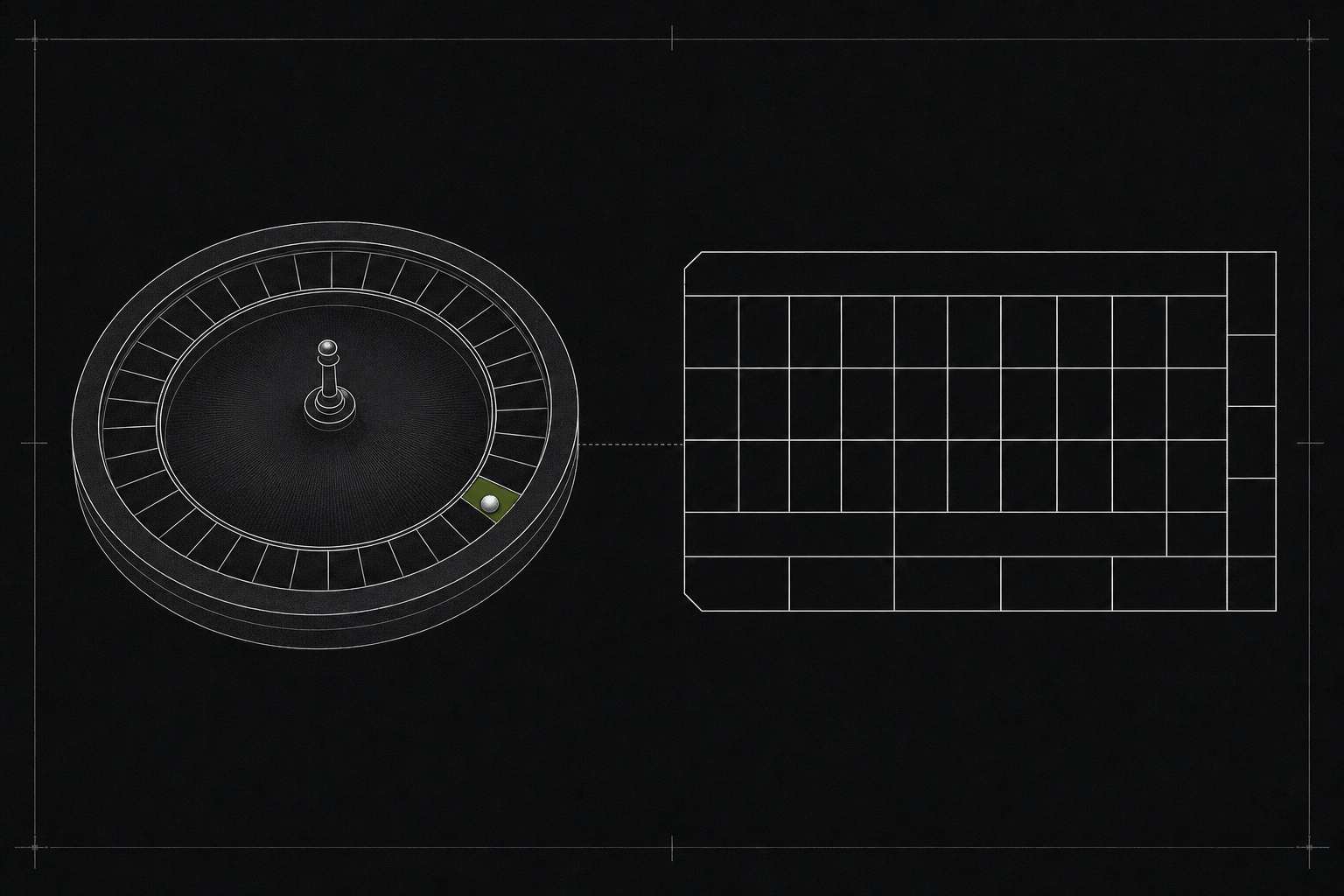
How live roulette works online
Five steps, repeated every round. The variation between tables sits inside them.
- 01
The wheel is a physical object
A dealer spins a real wheel and releases a real ball. The number that wins is the pocket the ball settles in, in front of the camera, and it is the same number for everyone betting on that spin.
- 02
Betting closes before the spin
You place chips on a digital layout that maps to the felt in the studio. A countdown governs the betting window; when it ends, no further bets are accepted for that round.
- 03
There is no seat limit
Because nobody is dealt a hand of their own, a live roulette table can take an unlimited number of players at once. Nothing about your bet depends on how busy the table is.
- 04
The result is announced and displayed
The winning number is called and shown on screen, together with the recent history most tables keep beside the wheel. That history is a record of what has already happened and carries no information about the next spin.
- 05
Settlement, then the next round opens
Winning bets are paid at the odds published in that table’s paytable and the next betting window opens. Many tables run to a fixed cadence, which is why the pace differs noticeably between them.
Live roulette tables and the wheels behind them
Wheel families first, because the wheel decides more about a table than its presentation does.
- Single-zero wheel
- Thirty-seven pockets: the numbers 1 to 36 plus one zero. This is the layout most commonly presented to UK players and the baseline the other variants are measured against.
- Double-zero wheel
- Thirty-eight pockets, because a second zero is added. The extra pocket does not change how you bet, but it does shift the balance of the table against the player on almost every bet available.
- French rules on a single-zero wheel
- Some tables add a rule covering even-money bets when the ball lands in zero — the stake is either returned in part or held for the next spin. Whether a table applies it is a table rule and changes the outcome of those bets.
- Speed tables
- The same wheel with a shorter betting window and a faster settlement cycle. The rules are unchanged; the number of rounds per hour is not.
- Automatic and airball tables
- The wheel is spun mechanically instead of by a dealer. The wheel is still physical and the result is still drawn in front of the camera, but there is no dealer, which some players are specifically looking for and others specifically are not.
- Venue-streamed tables
- A table on a real casino floor rather than in a studio, with online players betting on the same wheel as the people standing at it. One first-party verified case is documented on the homepage
Two live roulette tables can look nearly identical and still be different products: one may run a single-zero wheel with the French rule on even-money bets, the other a double-zero wheel with none. Because that distinction is invisible in a lobby thumbnail, it is one of the first things worth reading on the table itself — from its own published rules, not from a guess about what a studio usually does. If you want the venue-streamed case in detail, the one table we have verified first-party is described in the venue-stream section on the homepage.
The anatomy of a live roulette table
Two surfaces do all the work: the wheel that produces the number, and the layout that decides how you are allowed to bet on it.
The wheel is divided into numbered pockets around a rim, with a single zero on the layout most commonly presented to UK players. The croupier spins the wheel one way and releases the ball the other; the pocket the ball settles in is the result, and it is the same result for every player on that spin regardless of how many are betting.
The betting layout is a printed grid rather than a picture of the wheel, and the two are ordered completely differently. The numbers run in sequence on the felt and in a scattered order on the wheel, which is why bets that describe a region of the wheel — the announced bets — need a separate betting surface, usually drawn as an oval racetrack beside the main grid.
The rest of the furniture is functional. A statistics panel records recent numbers, a chip rack sets the denominations available at that table, and the limits displayed apply to that table alone. Two tables in the same lobby can run different wheels and different limits while looking almost identical in a thumbnail.
Bet families in detail
Every roulette bet belongs to one of three families. The family decides how often it wins and how much it returns when it does.
Inside bets sit on the number grid and cover between one and six numbers. A straight bet covers a single number; a split covers two adjacent numbers by placing a chip on the line between them; a street covers a row of three; a corner covers the four numbers meeting at a point; and a six-line covers two adjacent rows. They win rarely and pay proportionally more, and each table publishes the exact odds in its paytable.
Outside bets sit around the edge of the grid and cover large groups: red or black, odd or even, the low or high half, one of the three dozens, or one of the three columns. They win far more often and pay proportionally less. The zero belongs to none of them, which is the entire reason the wheel has an edge on these bets and the reason the French rule described above exists.
Announced bets follow the order of numbers on the wheel rather than the grid. They are placed on the racetrack surface and cover a named section — a group around the zero, a group opposite it, or a set of numbers stranded between the two — plus neighbour bets, which cover a chosen number together with those physically beside it on the wheel. A table either offers this surface or it does not, and that is a property of the table.
Two things are true of all three families and worth stating plainly. Each bet is settled independently, so a spin can win one of your bets and lose another. And no combination of them changes what the wheel does: covering more numbers wins more often for less, and covering fewer wins less often for more, which is the whole of the arithmetic.
The wheel decides the number. The layout only decides how you were allowed to describe it in advance.
The croupier and the rhythm of a table
The croupier runs the round: opening and closing betting, spinning the wheel, releasing the ball, calling the winning number and clearing the losing chips. On a live stream they are also the pace-setter, and the difference between a standard and a speed table is largely a difference in how much time they leave between those actions.
Some tables replace the croupier with a mechanical wheel that spins and releases the ball automatically. The wheel is still physical and the draw still happens on camera; what disappears is the person. Players tend to have firm preferences in one direction or the other, which is why it is worth naming as a format rather than treating all roulette tables as interchangeable.
The rhythm of a table is one of its most noticeable properties and one of the least documented. Round length, the length of the betting window, and how long results stay on screen all differ, and none of it is usually published anywhere we could cite. So the only reliable way to judge pace is the table in front of you, which is why this page describes the variable rather than putting a number on it.
One thing that is uniform: once the croupier announces no more bets, nothing about your stake can change. There is no way to retract, extend or adjust a bet mid-spin, and no interface offers one.
The announcements themselves are worth learning, because they are the same everywhere and they are the only instruction you get. Betting is invited, then closed, then the wheel is spun and the ball released, then the winning number is called and the layout cleared. If the ball fails to complete its circuit or leaves the wheel, the croupier declares the spin void and the round is replayed — stakes stand, nothing is lost, and the table simply goes again.
It is also worth knowing how a table settles a screen full of chips. Each bet is resolved on its own terms against the single number that came up, so one spin can pay two of your bets and take four others. Nothing is netted off before settlement and no bet protects another; a layout covered in chips is a set of separate wagers that happen to share a spin.
Live roulette terminology
Words that appear on the table, on the racetrack and on this page.
- Croupier
- The dealer at a roulette table, who spins the wheel and calls the result.
- One numbered slot on the wheel; the ball settles in exactly one per spin.
- Racetrack
- An oval betting surface ordered by the wheel rather than by the grid.
- Neighbour bet
- A bet covering a chosen number and those beside it on the wheel.
- Straight
- A bet on a single number — the narrowest bet on the layout.
- Outside
- The large-group bets around the edge of the grid, none of which include zero.
- Dozen
- One of the three twelve-number blocks the grid is divided into.
- La partage
- A rule returning part of an even-money stake when the ball lands in zero, where a table applies it.
- Statistics panel
- The display of recent numbers beside the table; a record, not a prediction.
Bet types and how the layout is organised
Every table publishes its own paytable. What follows is the structure of the betting surface, which is common to the game.
- Inside bets
- Bets on a single number or on a small group of numbers that touch each other on the layout — a pair, a row, a corner or two adjacent rows. They win rarely and pay proportionally more.
- Outside bets
- Bets on large groups: red or black, odd or even, high or low, the dozens and the columns. They win often and pay proportionally less. Zero is not part of any of them, which is where the French rule above matters.
- Announced bets
- Named groupings that follow the order of the numbers on the wheel rather than the grid on the felt. Not every table offers them, and the ones that do usually present them as a separate betting surface.
What the payouts tell you about the wheel
The odds printed beside each bet are not arbitrary, and reading them together explains something the betting surface hides: almost every bet on the table is the same bet wearing a different shape.
A single number on a European wheel pays thirty-five to one. There are thirty-seven pockets, so a winning stake comes back as thirty-six units in total — the payout is calculated as though the wheel had thirty-six pockets rather than the thirty-seven it actually has. That one missing pocket is the whole of the house's margin, and it is not hidden in the mechanism or in the dealer; it is written on the paytable in plain sight.
Work the same arithmetic across the rest of the surface and the answer barely moves. A split covering two numbers pays seventeen to one, a corner covering four pays eight to one, a dozen covering twelve pays two to one, and an even-money bet covering eighteen pays one to one. In every case the payout treats the wheel as if the zero were not there. Spreading a stake across more of the layout changes how often you win and how much you win, and it does not change the balance of the table at all.
This is why the wheel matters more than the bet. A second zero adds a thirty-eighth pocket while the paytable stays where it was, so the same bets become worse on that table — and it is why the rule some single-zero tables apply to even-money bets when the ball lands in zero is the one genuinely favourable variation on the surface, because it gives part of that stake back rather than adjusting a payout.
The layout offers dozens of ways to describe a spin. On a given wheel, almost all of them cost the same.
Live roulette in the UK: what the licence covers
A site offering live roulette in the UK holds a remote casino licence from the UK Gambling Commission, and the public register publishes the licensee behind the brand, the licence number and the date the current licence record began. Those are the facts in the operator list on the homepage, taken from the register itself.
What a licence does not describe is the table you are about to open: which wheel it uses, whether the French rule applies, how fast it runs, or which studio produces it. Those are table-level facts, they change without notice, and we record them only where a published source states them.
The bet-family map
Every chip you can place on a live roulette table belongs to one of three families, and the family tells you almost everything: how many pockets the bet covers, how often it can win, and where on the surface it lives. Coverage below is counted against a single-zero wheel of thirty-seven pockets.
| Bet | Family | Pockets covered | Where you place it |
|---|---|---|---|
| Straight | Inside | 1 of 37 | On a single number in the grid |
| Split | Inside | 2 of 37 | On the line between two adjacent numbers |
| Street | Inside | 3 of 37 | On the edge of a row of three |
| Corner | Inside | 4 of 37 | On the point where four numbers meet |
| Six-line | Inside | 6 of 37 | On the edge shared by two rows |
| Column | Outside | 12 of 37 | At the foot of one of the three columns |
| Dozen | Outside | 12 of 37 | Beside one of the three twelve-number blocks |
| Red or black | Outside | 18 of 37 | On the colour boxes along the side |
| Odd or even | Outside | 18 of 37 | On the parity boxes along the side |
| High or low | Outside | 18 of 37 | On the 1–18 and 19–36 boxes |
| Neighbours | Announced | A chosen number and those beside it on the wheel | On the racetrack, where a table offers one |
| Wheel sections | Announced | A named run of pockets in wheel order | On the racetrack, where a table offers one |
Read down the coverage column and the structure of the game appears. The bets are a sliding scale from one pocket to eighteen, and the return moves in the opposite direction at every step. There is no bet on the layout that covers more ground and pays the same, and no arrangement of chips that changes the relationship — a combination of bets is just several bets settled separately on the same spin.
The zero is the reason the scale is not symmetrical. The three even-money families each cover eighteen pockets out of thirty-seven rather than half of the wheel, because the zero belongs to none of them. That single pocket is the entire structural difference between roulette and a coin toss, and it is why the French rule — which returns or holds part of an even-money stake when the ball lands in zero — changes those bets materially wherever a table applies it.
A double-zero wheel extends the same logic by one pocket. Nothing about how you bet changes, the layout looks nearly identical, and every bet on it covers its numbers out of thirty-eight rather than thirty-seven. That is the whole difference, and it is worth checking before you sit down rather than after.
Which sites run which wheels is a different kind of question, and it belongs to the table rather than to this page: it changes without notice, appears in no durable published form, and would be stale long before anyone read it. The wheel in front of you states its own answer — the pocket count and any zero rule are both in its rules panel. How we verify explains where we draw that line and why.
What the statistics panel is for
Every live roulette table displays its recent numbers, usually with hot and cold markers. It is the most misread element on the screen.
The panel is a record. It says what the wheel produced over the last several dozen spins, sometimes broken down by colour, parity and section. As a record it is accurate, and as entertainment it is part of why people stay at one table rather than another.
What it cannot do is describe the next spin. The wheel has no memory of its previous results: the ball is released into the same thirty-seven pockets every time, and a number that has appeared four times in an hour is exactly as likely on the next spin as one that has not appeared at all. Neither "it is due" nor "it is running hot" survives contact with how the apparatus works.
This matters more in roulette than in the other live categories, because roulette is the one where the display invites the inference. A blackjack table shows you a hand history nobody reads as a forecast; a roulette table shows a grid of numbers with the frequent ones highlighted, which looks like an instrument even though it is a scoreboard.
The practical use of the panel is narrow but real: it tells you which wheel you are watching. A quick glance shows whether zero has appeared, whether the table is running at the pace you expected, and how many spins have happened since you arrived. That is what it is good for, and it is the only thing it is good for.
The panel is a record of the past written in the language of a prediction. Read it as history and it is useful; read it as a signal and it will cost you.
Live roulette against the other three live categories
Roulette is the most widely offered of the four families and the easiest to join: no seat, no queue, no decision after the bet. That last point is worth dwelling on, because it is where the category differs most from live blackjack, the only family where what you do after the cards are dealt changes the result. If you find in-round decisions stressful, roulette removes them entirely.
Against live baccarat, the difference runs the other way. Baccarat offers three bets and no more; roulette offers dozens of ways to describe a single spin, from one pocket to eighteen, plus a second betting surface ordered by the wheel. It is the most expressive of the four and the one with the longest learning curve that is not about strategy.
Against the live game shows, roulette is the stable one. A wheel is a wheel: the format has not meaningfully changed in living memory, the rules are the same in every studio, and only the presentation and the pace differ. Game show formats are introduced and withdrawn on a commercial schedule, which makes them more varied and less dependable as something to come back to.
The one place roulette does vary structurally is the wheel itself, and it is the thing worth checking each time: how many pockets, and whether the table applies a rule for even-money bets when the ball lands in zero. Two tables side by side in the same lobby can differ on both.
The other live casino categories
Each family is described the same way: how a round works, what belongs to the individual table, and where the published rules can be read. The format comparison on the homepage puts all four side by side, alongside the operator list.
Common questions about live roulette
Does a live roulette table ever run out of space?
No. Nobody is dealt a hand, so every player at a live roulette table bets on the same spin of the same wheel. A table can be busy without that affecting your bet, which is the main structural difference between this category and live blackjack.
What is the difference between a single-zero and a double-zero table?
The number of pockets on the wheel. A single-zero wheel has thirty-seven, a double-zero wheel has thirty-eight because a second zero is added. You bet in exactly the same way on both, but the additional pocket tilts the table further against the player on nearly every available bet.
What is a venue-streamed live roulette table?
A table streamed from a real casino floor instead of a studio, so online players bet on the same wheel as the players physically at it. We only describe a table this way where we have read the operator’s own page saying so — currently one case, documented on the homepage.
Can the recent numbers beside the wheel tell me what is coming next?
No. The history panel records what has already happened. Each spin is independent of the ones before it, and no pattern in that list changes the odds of the next result.