BJK · Category
Live Blackjack in the UK: How the Online Tables, Seats and Rules Work
Live blackjack in the UK is dealt from a real shoe at a real table, in a studio, on camera. The differences that matter to a player are rarely in the rules of blackjack itself: they are in how a particular table is built — how many betting positions it has, what happens when they are all taken, how long you get to decide, and which dealer rules and side bets apply.
This page explains how the format works online and what can honestly be said about it. Where a detail belongs to an individual table rather than to the game, it is named as such, and where there is no source for it, it stays marked as unknown instead of being filled in.
How live blackjack works online
Five things happen in every round, and each one is where tables differ from each other.
- 01
The table is a real one
A dealer stands at a physical blackjack table in a studio, with a real layout and a real shoe of cards. The hand you are betting on is dealt in front of the camera as it happens.
- 02
You take a position, not a screen
Betting positions are printed on the felt. Joining an online table assigns you one of them for as long as you keep playing, and how many positions exist is a property of that table rather than of blackjack.
- 03
The round runs on a clock
Betting is open for a set number of seconds, counted down on screen. When it closes the dealer deals. Sitting a round out costs nothing and does not give up your position.
- 04
Decisions have their own countdown
Hit, stand, double and split appear as controls with a timer of their own. If the timer runs out the table applies its own default action instead of waiting, which is one of the details worth reading in a table rules panel before you sit down.
- 05
Settlement happens at the table
Wins are paid to the positions on the felt and the shoe continues into the next round. When the shoe is reshuffled is set by that table, not by the game.
Live blackjack tables and how the seats work
A live blackjack table has a fixed number of betting positions — traditionally seven, though a table can be built with fewer. That single constraint drives most of what a player actually notices, because a popular table fills up and a physical shoe cannot deal to an unlimited number of hands at once.
Studios answer the constraint in three different ways, and the answer changes what you get for your stake: a position of your own, a bet on somebody else's hand, or a copy of one hand that everybody plays independently. None of the three is better than the others in the abstract — they are different products, and knowing which one you have joined is the difference between waiting for a seat and never seeing a queue.
- 1
- 2
- 3
- 4
- 5
- 6
- 7
- bet behind
A seven-position table with a bet-behind option. The number of positions and whether bet behind exists at all are properties of the table.
Check before you join
- How many positions the table has
- Whether any of them are free right now
- Whether bet behind is offered when they are not
- Whether it is a shared-hand table, which removes the question
The anatomy of a live blackjack table
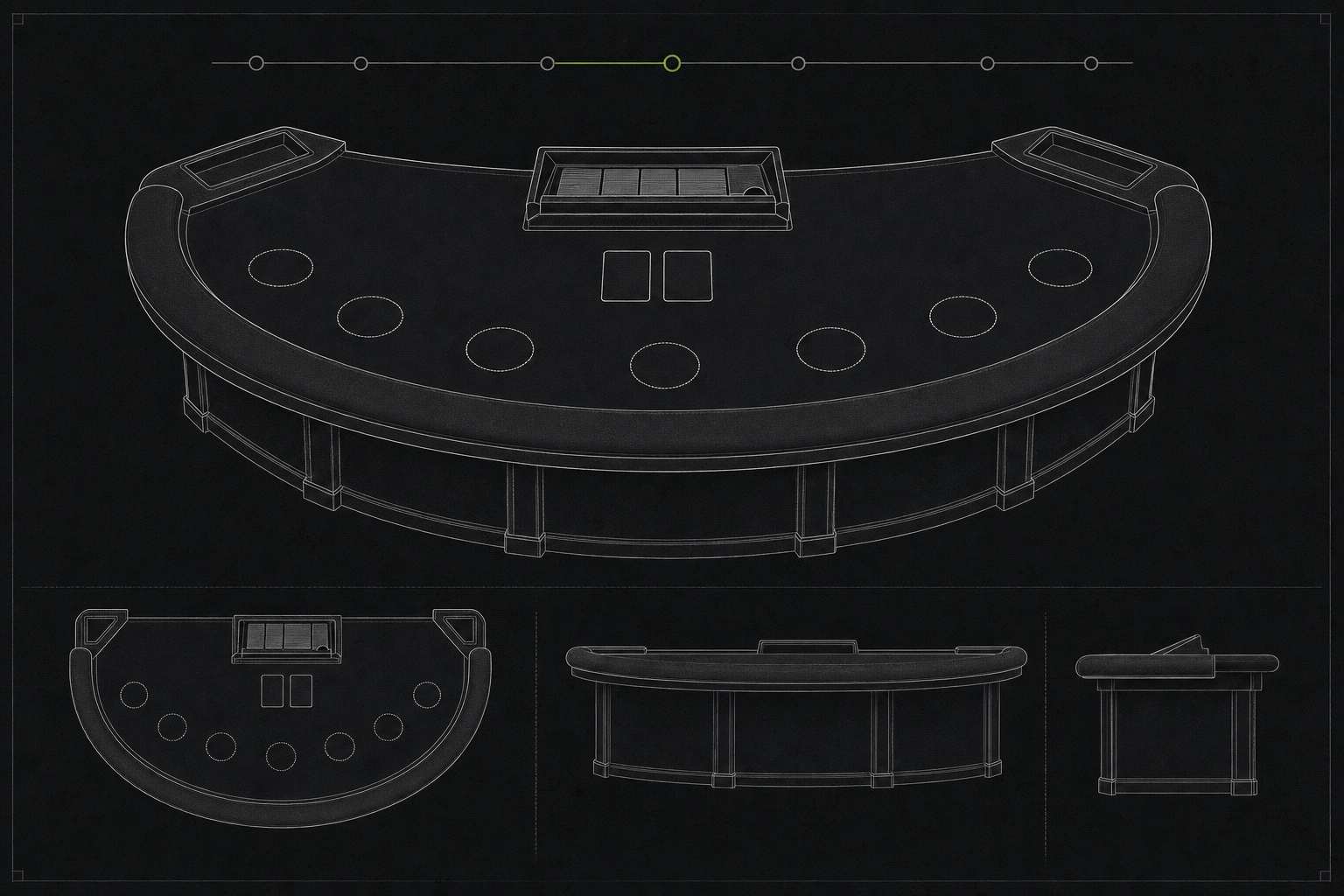
Everything that varies between tables is visible in the furniture: how many positions there are, where the cards come from, and where they go afterwards.
The dealer stands at the flat side of a curved table with a shoe on one side and a discard tray on the other. Betting positions are printed along the curve, and the number of them is the single most consequential fact about the table: it decides whether you can sit, whether you will queue, and whether a bet-behind option exists at all.
The shoe holds several decks shuffled together and is the reason a live table has a shuffle point. A marker placed near the end of the shoe signals when the cards will be replaced; where that marker sits is a table rule, not a rule of blackjack. The discard tray beside the dealer holds the cards already played, and between the two of them you can see roughly how far through a shoe a table is.
The camera framing matters more than it sounds. A table shot from above shows the whole layout and every position at once; a table shot from the dealer's side shows the cards larger but less of the felt. Neither is better, but the two produce noticeably different experiences of the same game, and it is one of the things a lobby thumbnail never tells you.
The decisions you actually make
Blackjack is the only one of the four live categories where play decisions exist. These are the ones a live table offers, and what each of them commits you to.
Hit takes one more card. It is the only decision that can end your hand immediately, and the interface will keep offering it until you stand or go over twenty-one. Stand ends your turn and passes play to the next position; once taken it cannot be undone, and the timer does not return.
Double matches your original stake in exchange for exactly one further card, after which your hand is finished whether you like the card or not. Whether a table allows doubling on any two cards, or only on certain totals, and whether it allows doubling after a split, are table rules published in its rules panel.
Split turns a pair into two hands, each taking a stake equal to the first. How many times a hand may be split, and whether split aces receive more than one card, differ between tables and change the game materially.
Insurance appears only when the dealer's upcard is an ace. It is a separate bet on the dealer holding blackjack rather than a decision about your own hand, and the interface offers it on a short timer of its own.
Surrender, where a table offers it at all, gives up half the stake and ends the hand before any further cards are drawn. It is far from universal, and its presence or absence is a property of the table.
Two structural details are worth knowing before you sit down. Some tables deal the dealer a second card face-down at the start of the round and some do not, which changes what happens to doubled and split stakes when the dealer turns out to have blackjack. And every decision runs on its own countdown: if it expires, the table applies its default rather than waiting, which is the detail most worth reading in the rules panel first.
None of these rules is set by the studio, the operator or the game of blackjack. Each one is set by the individual table and printed on it — which is why the table, not the title above it, is the thing worth reading.
| Decision | What it commits | When it is offered | What the table sets |
|---|---|---|---|
| Hit | One more card, with no additional stake | Any time it is your turn and your hand is still live | Nothing — this one is the same at every table |
| Stand | Your hand as it is; the turn passes and cannot be recalled | Any time it is your turn | Nothing, beyond how long the timer gives you |
| Double | A second stake equal to the first, for exactly one more card | On the first two cards, at most tables | Whether it is allowed on any two cards or only on certain totals, and whether it is allowed after a split |
| Split | A second stake, turning one pair into two separate hands | When the first two cards are a pair | How many times a hand may be split, and whether split aces receive more than one card |
| Insurance | A separate side stake on the dealer holding blackjack | Only when the dealer’s upcard is an ace, on a short timer of its own | Whether the table offers an even-money shortcut when you hold blackjack yourself |
| Surrender | Half the stake, in exchange for ending the hand immediately | On the first two cards, at the minority of tables that offer it | Whether it exists at all — most live tables do not offer it |
The shoe, the shuffle point and what they do not mean
A live blackjack table deals from a shoe holding several decks shuffled together, and somewhere near the end of it sits a cut card. When that card appears, the current hand finishes and the shoe is replaced. How deep the cut card sits is a property of the table, and it is the reason two tables with identical rules can feel different over an hour: one reshuffles noticeably more often than the other.
The discard tray beside the dealer is the other half of the same picture. Cards already played are stacked there in plain view, so the two trays together show roughly how far through a shoe the table has got. It is one of the few pieces of information a live table gives you that a software table structurally cannot.
What none of that supports is the idea that the visible state of the shoe tells you what is coming. Counting systems developed for a physical casino depend on seeing every card dealt to every position, on a shoe played deep, and on being able to vary a stake between hands without anybody minding. An online table shows you your own hand and the dealer's, reshuffles on its own schedule and applies its own betting limits, and the arithmetic that makes counting work does not survive the transfer.
The honest position is the dull one. The shoe's history is visible, it is interesting, and it does not predict the next card. Treat it as part of the furniture rather than as information you can act on, and the game becomes much easier to think about clearly.
Reading a live blackjack interface
What the panels around the video are telling you, and which of them matter.
The betting area shows chip denominations and the table's minimum and maximum for the main bet. Those limits belong to that table and can differ between two tables in the same lobby, so the figure on screen is the only one that applies to the seat you are in.
A countdown governs the betting window, and a second countdown governs each decision once the cards are out. A seat map shows which positions are occupied, which is how you can tell before joining whether you will be seated or waiting.
A history strip records recent results at that table. It is a record of what has already happened and carries no information about the next hand — the shoe does not remember, and neither does the strip.
The rules panel is the one to open first. It carries the dealer's standing rule, the doubling and splitting limits, the side bets on offer and their paytable, and the default action applied when a timer expires. Everything this page describes as varying by table is written there.
Live blackjack terminology
The words that appear on the table, in the rules panel and on this page.
- Upcard
- The dealer's face-up card, visible before you decide anything.
- Hole card
- A dealer's face-down second card, dealt at the start on tables that use one.
- Shoe
- The box the cards are dealt from, holding several decks shuffled together.
- Cut card
- The marker set near the end of the shoe that signals the shuffle point.
- Bet behind
- A stake on a seated player's hand, placed from outside the table.
- Shared hand
- A format where every player receives the same dealt hand and decides on it independently.
- Blackjack
- An ace with a ten-valued card on the first two cards, which ends the hand at once.
- Push
- A tie between your hand and the dealer's, returning the stake.
- Side bet
- An optional bet on the first cards dealt, offered and priced per table.
Formats and variants you will meet at the table
These are format families rather than product names. A lobby may carry several of them under branded titles.
- Classic seated table
- A fixed set of betting positions, one hand per position, dealt from a shoe. What changes between tables is the number of positions and the side bets on offer.
- Bet behind
- Where a table offers it, a position that is already taken can still be backed: you stake on a seated player’s hand and are paid on their result, with no say in how it is played.
- Shared-hand tables
- Every player is dealt the same starting hand and then decides independently, which removes the seat limit altogether. Your split or double applies to your own copy of the hand.
- Speed and low-stake variants
- The same rules with shorter betting and decision windows, or with a lower entry. Pace belongs to the individual table, so we record it only where a source states it.
- First-person and hybrid tables
- Some tables place a software layer over the stream, and some brands run a software-only version under a name very close to the live one. That difference matters if you specifically want a real dealer, so the two are worth treating as separate formats rather than as variants of one.
- Side bets
- Most live blackjack tables offer optional bets on the first cards dealt. Which ones exist, and what they pay, is a table rule and not a property of the game. Read the table’s own rules panel — we do not restate paytables from memory
- Dealer and player rules
- Whether the dealer stands on all seventeens, whether doubling after a split is allowed, and how often a hand may be split are all set per table and change the maths of the game. They are published in each table’s rules panel.
When a round does not finish cleanly
Rounds at live blackjack tables occasionally go wrong, and the possibilities are narrower and less alarming than most players assume. It is worth knowing the shape of them before one happens.
The common one is losing your connection mid-hand. The hand does not stop, because it is a physical hand being dealt to a physical position in front of a camera, and the other people at the table are still in it. What happens to your position is decided by the table's own rules: usually the default action attached to the decision timer is applied on your behalf, exactly as it would be if you had simply let the timer run out while watching. The round is then settled normally and the result is waiting for you when you return. This is the practical reason the default action is worth reading before you sit down rather than after — it is the rule that plays your hand when you cannot.
Rarer is a problem at the table itself: a card exposed in error, a card dealt to the wrong position, a shoe or shuffler fault, or a dealer mistake caught on camera. These are handled under the table's published rules of play rather than case by case, and the usual outcome is that the affected hand is declared void and stakes on it are returned. A void hand is not a loss and is not a win; it is the round being unwound.
The distinction that matters is between the two authorities involved. What happens to a hand is governed by the rules of play for that table. What happens to your money and how a disagreement is escalated is governed by the operator's own terms, and the two are separate documents held by separate parties. If a round goes wrong, both are worth reading, and the timestamp of the round is the thing that identifies it in either.
A live hand cannot be paused for one player. Every rule covering an interrupted round exists because the table has to keep going without you.
Live blackjack in the UK: what the licence covers
Any site offering live blackjack in the UK needs a remote casino licence from the UK Gambling Commission. The public register publishes the licensee behind the brand, the licence number and the date the current licence record began, and those are the facts carried by the operator list on the homepage — read from the register itself rather than from the operator's own marketing.
A licence tells you that a site is regulated here and who is legally accountable for it. It tells you nothing about which live blackjack tables that site carries today, what its table limits are, or how good the stream is. Those are separate questions, and where we cannot source them they stay open. Self-exclusion through GAMSTOP applies across every site licensed in Great Britain, which is one of the few things that is genuinely uniform across the category.
The eight table rules worth checking before you sit down
Every one of these is decided by the individual table and published by it. Together they account for most of the difference between two live blackjack tables that look the same in a lobby, and all eight can be read in under a minute.
| Rule | What it changes | Where it is published |
|---|---|---|
| Dealer standing rule | Whether the dealer draws on a soft seventeen. It is the single largest rule difference between two otherwise identical tables | Rules panel, usually the first line |
| Number of decks | How the shoe behaves and how often it is reshuffled | Rules panel, and often the lobby tile |
| Double after split | Whether a split hand can be doubled — a common restriction, and a meaningful one | Rules panel, under doubling |
| Resplit limit | How many hands one pair can become, and whether aces can be resplit | Rules panel, under splitting |
| Hole card | Whether the dealer takes a second card at the start, which decides what happens to doubled and split stakes against a dealer blackjack | Rules panel, under dealing |
| Timer default | What the table does for you when a decision timer expires | Rules panel, under timing |
| Side bets offered | Which optional bets exist on the first cards, and what each returns | Rules panel, with the paytable beside each bet |
| Positions and bet behind | Whether you can be seated, and whether you can back somebody else’s hand when you cannot | Visible on the table itself, before you join |
The order of that list is roughly the order of how much each one matters. The dealer's standing rule and the doubling restrictions move the arithmetic of the game; the timer default and the side bets change what happens to you in practice; the number of positions decides whether you play at all in the next five minutes. None of it is hidden — all of it sits behind one control on the table interface.
What we deliberately do not publish is a list of which sites carry which of these tables. That relationship changes without notice, is visible in most cases only once you are signed in, and is not published in any durable form by the studios or by the operators. A table-by-table availability list would look authoritative and go stale within weeks, so the useful thing we can offer instead is the reading list above.
The same applies to stake limits. They differ between two tables in the same lobby, they differ by currency and sometimes by account, and the only figure that binds is the one displayed on the table you have actually opened. Any range quoted elsewhere is a snapshot of somebody else's session.
Everything on this page that is stated as fact is a rule of the game or a description of how live tables are built, and holds regardless of where you play. How we verify sets out the evidence standard in full, including what we treat as a source and what we refuse to treat as one.
Live blackjack against the other three live categories
Blackjack is the outlier of the four families, and knowing how it differs is the fastest way to decide whether it is the one you want.
It is the only one with a seat limit. Live roulette, live baccarat and the live game shows all settle one event that the whole table shares, so any number of players can bet on the same round. Blackjack deals a hand per position, and a physical shoe cannot serve an unlimited number of hands at once — which is why bet behind and shared-hand formats exist at all.
It is also the only one where anything you do after the bet changes the outcome. That cuts both ways: there is something to learn and something to get wrong, where baccarat offers neither. A round takes longer for the same reason, because the table waits for each position in turn.
The consequence for a newcomer is worth stating plainly. Blackjack rewards reading the rules panel more than any other live category, because more of the game is defined there. In roulette the wheel is the rule and it is visible; in baccarat the drawing rules are fixed and identical everywhere; in a game show the format is the rule and it is announced. Blackjack alone hides its most important variables behind one link.
If that sounds like work, it is worth remembering how little of it there is: eight lines, read once per table, and the same eight lines at every table you ever join.
The other live casino categories
Each family is described the same way: how a round works, what belongs to the individual table, and where the published rules can be read. The format comparison on the homepage puts all four side by side, alongside the operator list.
Common questions about live blackjack
Is live blackjack the same game as the software version?
The rules belong to the same family, but the two are not the same product. A software table generates its cards; a live blackjack table has them dealt physically on camera, and its specific rules — dealer standing rules, splitting and doubling limits, side bets — are set for that table. Live and software versions of a similarly named table are worth treating as separate products for exactly that reason.
What happens if every seat at a live blackjack table is taken?
On a classic seated table you either wait for a position to free up or, where the table offers it, back a seated player’s hand with a bet behind. Shared-hand tables avoid the problem entirely because every player receives the same dealt hand and plays their own decisions on it.
Do all UK live blackjack tables use the same rules?
No, and this is the most common misreading of the category. Dealer rules, doubling and splitting limits, the number of decks in the shoe and the available side bets are decided per table and shown in that table’s rules panel. Two tables in the same lobby can differ.
Why does this page not list which sites carry which blackjack tables?
Because that relationship is only a fact if we can point at a source for it, and no durable public source exists. We can read licence records for the operators we cover, from the UK Gambling Commission register, but which live blackjack tables a site carries today is published by nobody in a checkable form and changes without notice. The rules that vary between tables are documented instead, because those are stable and published on the table itself.